REVIEW · BELFAST
Original Private Belfast Troubles and Peace Cab/Taxi Tour 2 Hours
Book on Viator →Bookable on Viator
Two hours in one black taxi, and Belfast gets real. I like the first-hand storytelling from a driver who lived through the Troubles, and I also like the private, door-to-door feel that keeps things easy in a city where history can feel heavy. One heads-up: a couple of stops are marked with admission not included, so you may hit a small extra cost depending on what’s open that day.
This is a short tour, so you get focused time at the key street-art sites and political landmarks, with chances to step out and take pictures. It runs about 2 hours, in English, and you’ll start and end at Belfast City Hall unless you’ve arranged pickup outside the free zone.
In This Review
- Key things to know before you go
- A private black taxi tour of Belfast’s Troubles and peace walls
- Price and value: what you’re paying for
- Getting started at Belfast City Hall (and how pickup really works)
- The route in plain language: murals, peace walls, and streets that explain the past
- Divis Street’s international mural wall: global causes on a local street
- Bobby Sands mural and the Falls Road context
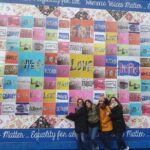
- Peace walls: writing a name on the barrier
- Bombay Street and the Provisional IRA story
- Shankill Road: loyalist heartland and UVF/UDA context
- A historic gaol building: Belfast’s jail era in view
- Saint Peter’s Cathedral and the song tied to the conflict
- Shankill Graveyard: mural photo time on gable walls
- What I like most about the guides (from the best experiences)
- Who this tour suits best (and who might want a different plan)
- Should you book this Belfast Troubles and Peace Cab Tour?
- FAQ
- How long is the private Belfast Troubles and Peace cab/taxi tour?
- Where does the tour start and end?
- Is pickup included?
- Can I get picked up from the airport, train station, or cruise port?
- What language is the tour offered in?
- Are any admissions or tickets included?
- Is this tour suitable for children?
- What is the cancellation refund policy?
Key things to know before you go
- Private black taxi means your group stays together the whole time
- Murals and peace walls do the teaching, not just plaques and timelines
- Time to get out for photos at multiple stops along the route
- Global and local themes show up side by side on the Divis Street international mural wall
- Built for questions: the guide’s perspective helps you connect the dots fast
- Two-sided context is part of the point, even when the streets feel split
A private black taxi tour of Belfast’s Troubles and peace walls
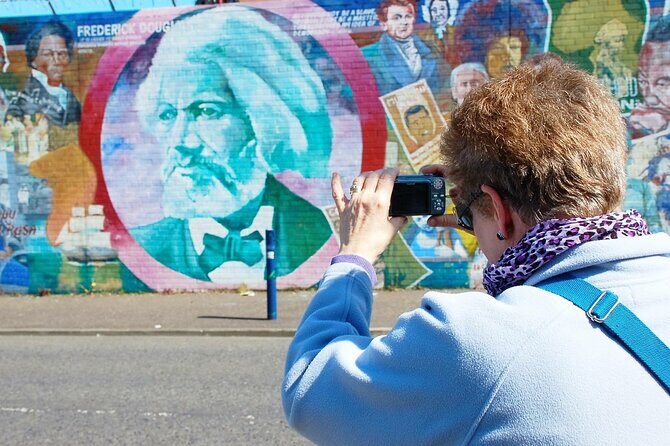
Belfast is one of those cities where street corners carry memory. This 2-hour private black taxi tour is designed for that reality. You ride through neighborhoods shaped by conflict, then you stop at murals, walls, and landmark buildings that explain what people fought over—and what they hoped for afterward.
The biggest reason this works is the human angle. The driver/guide isn’t reciting a script; they’re sharing lived experience. In the best moments, the conversation turns from facts into street-level understanding: what it felt like to drive those roads, how people talked about the future, and why the art on the walls became a kind of public speech.
I also like that it stays practical. You’re not doing this as a long walking day in the parts of town that can feel complicated. You get transport, short stops, and clear chances to step out for photos.
The topic is serious, though. If you’re sensitive to conflict history, you should know you’re going to see symbols, memorial imagery, and references to paramilitary groups and violence. You can still enjoy it—but come ready to be thoughtful, not shocked.
Other black taxi & cab tours in Belfast we've reviewed

Price and value: what you’re paying for
At $122.09 per person for about two hours, this isn’t the cheapest option. But it’s priced like a true private experience: your own black taxi and the attention that comes with not sharing your ride with strangers.
For value, the essentials are:
- Private group format (your group only)
- Central pickup within 1 km of Belfast City Hall front gates
- A route built around key sights that usually take longer to piece together on your own
Where you might feel the cost more is in the small details. A couple of sites are marked as admission ticket not included (notably Divis Street’s international mural wall and Shankill Road). If anything onsite has a fee during your visit, that would be on you.
Still, for most people, the trade-off makes sense. Two hours is short enough to keep it manageable, but long enough for the guide to explain the meaning behind what you’re seeing rather than just driving past it.
Getting started at Belfast City Hall (and how pickup really works)
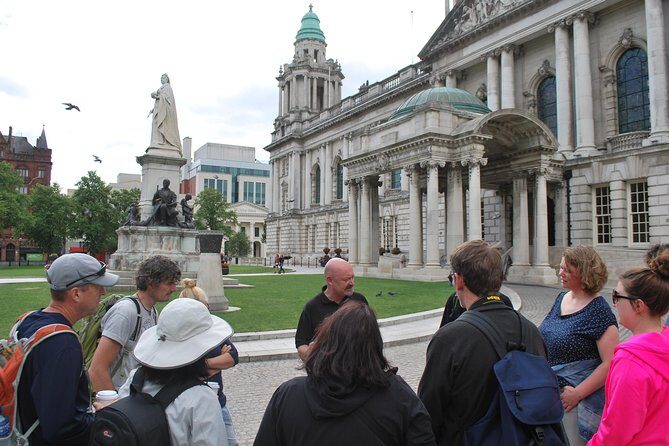
You meet at Belfast City Hall, Donegall Square N, Belfast BT1 5GS. The tour ends back at the meeting point, so it’s simple to plan the rest of your day.
Pickup is partly included:
- Free pickup is offered within a 1 km radius of Belfast City Hall
- If you’re staying outside that zone, pickup can still be arranged for an additional cash charge paid on the day
- Airport, train station, and cruise port pickups are not included and also require a cash surcharge on the day
The upside of this setup is predictability. If you’re staying near the city center, you can treat it like a hotel-friendly tour. If you’re further out, you just need to budget a little extra cash and message the provider ahead of time to confirm pickup points.
The route in plain language: murals, peace walls, and streets that explain the past
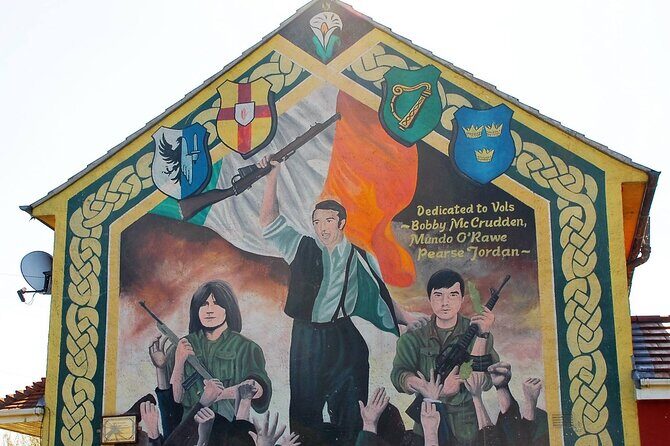
This tour moves through Belfast using street art and politically charged landmarks as your guide. Instead of starting with a classroom-style lecture, it starts with visuals—big mural walls first—then steps into communities defined by their history.
A nice thing here is pacing. You get short stops (often around 10–15 minutes) rather than long museum chunks. That matters because these areas are emotionally intense. Short, guided pauses help you process what you’re seeing without feeling rushed.
You’ll also notice that the tour keeps returning to the idea of public messaging. Murals aren’t just decoration; they’re statements. Peace walls aren’t just barriers; they’re spaces where people add their own words.
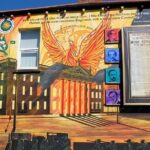
Divis Street’s international mural wall: global causes on a local street
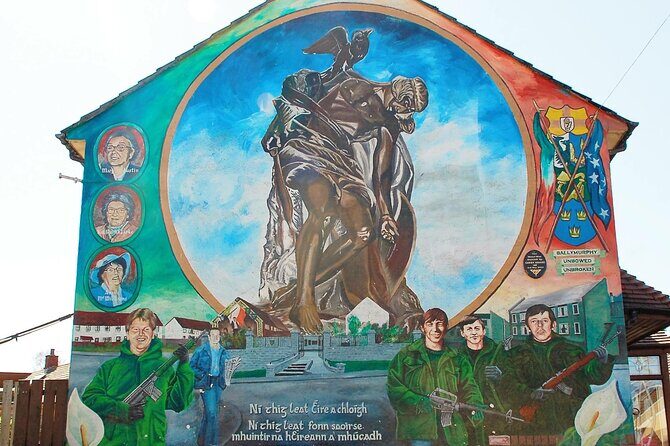
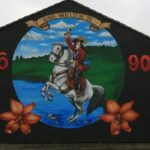
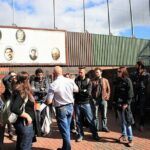
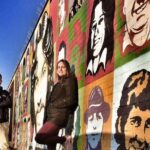
One of the strongest segments is Divis Street’s international mural wall. You’ll see large-scale murals tied to multiple countries and communities—like Cuba, Palestine, and the Kurds—showing solidarity and political messaging.
This is a smart choice for your understanding of Belfast. It tells you that local identity doesn’t exist in a vacuum. People in Northern Ireland followed international events, used global comparisons, and put those connections right onto city walls.
You’ll likely have time to get out for photos. Just note the tour listing marks at least one Divis Street mural stop as admission ticket not included, so be ready for any small onsite fee that might apply when the wall or viewing area has ticketing.
Other Troubles & political tours we've reviewed in Belfast
Bobby Sands mural and the Falls Road context
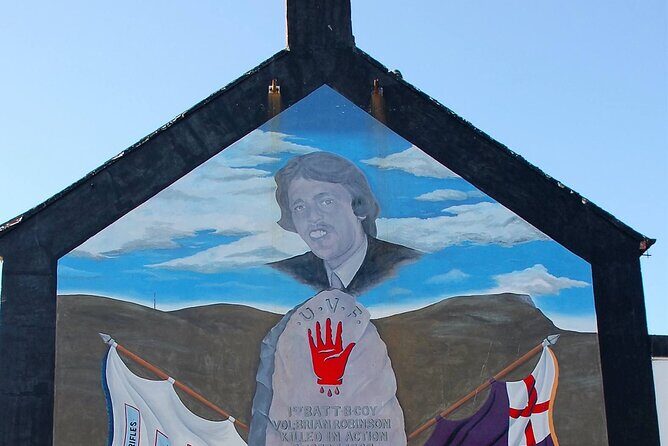
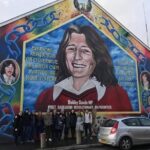
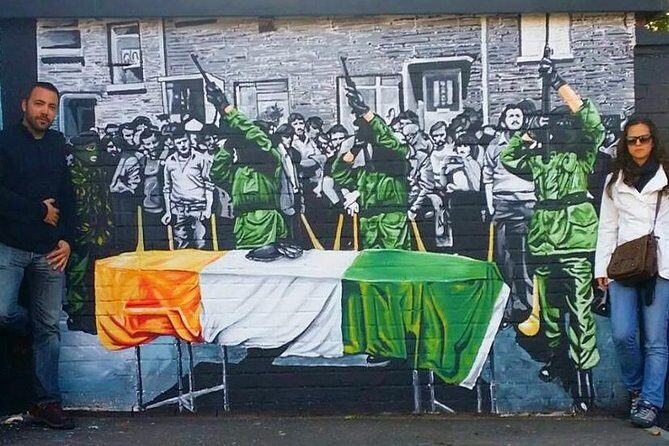
Next comes a mural focused on Bobby Sands, a figure central to the Troubles era. The guide connects this to the wider story of the Falls Road and references the famous Hollywood film Name of the Father as a cultural touchpoint people often recognize.
At this stop, the point isn’t to memorize names. It’s to understand why the murals are placed where they are, and why they keep appearing in the public conversation. Murals like this act like condensed history—almost like street-level news archives.
If you’re the type who likes asking why things are built the way they are, this is a good stop. The driver/guide can explain what it meant to live in those streets and what it felt like when the city’s boundaries were felt day to day.
Peace walls: writing a name on the barrier
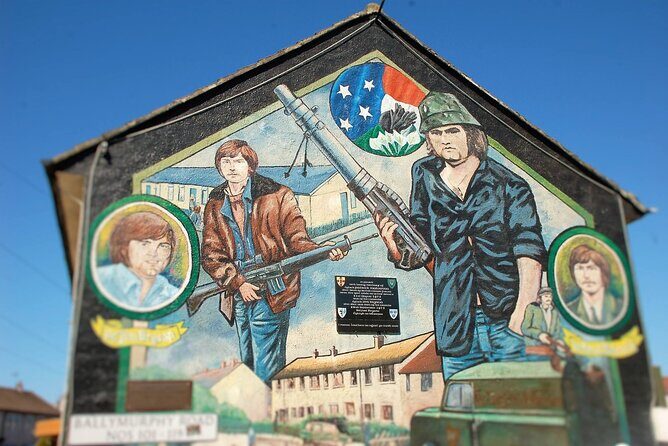
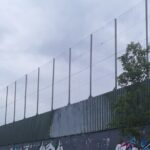
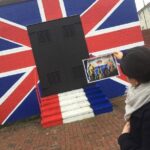
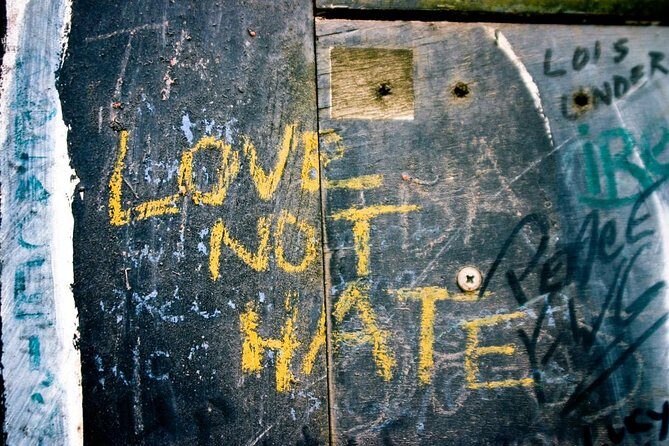
Then you reach one of Belfast’s most famous features: a major peace wall. You get the chance to write your name and a quote on the barrier. It’s a small moment, but it can land hard—in a good way—because it turns a physical divide into a shared act of reflection.
The wall also carries big-name references. The tour info notes that people including Lady Gaga, Morgan Freeman, and President Clinton have written quotes there. Whether you know all those names from history or pop culture, seeing celebrity quotes on a political barrier makes the idea of peace feel strangely real. It’s not a poster concept; it’s something people have touched.
Time here is typically around 15 minutes. You’ll want to bring your phone camera and some patience—writing space can take a bit of coordination when there are multiple visitors.
Bombay Street and the Provisional IRA story
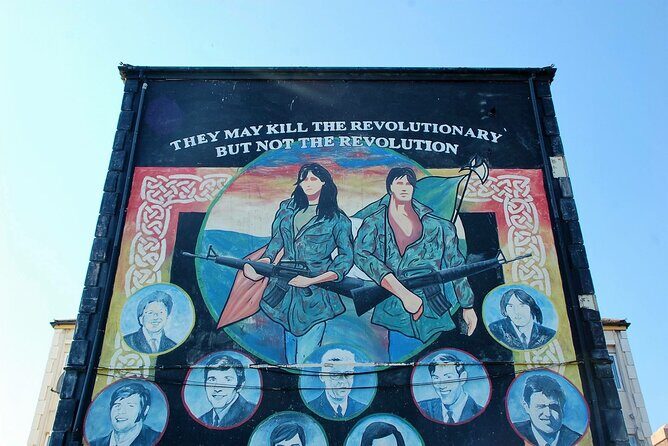
You’ll drive to the area linked to Bombay Street, described as having been burned down in 1969 by loyalist mobs and police. The tour frames it as connected to the rise of the Provisional IRA, including their long conflict with the British Army over more than 25 years.
This is one of those stops where the facts are only half the story. The other half is how the streets feel now. The guide’s job is to help you read the present-day street layout as a map of what happened before.
Because this is a short stop, don’t expect a full deep-history lesson on every detail. Instead, treat it as orientation: you’re learning what to notice later—names, boundaries, and which neighborhoods are tied to which narratives.
Shankill Road: loyalist heartland and UVF/UDA context
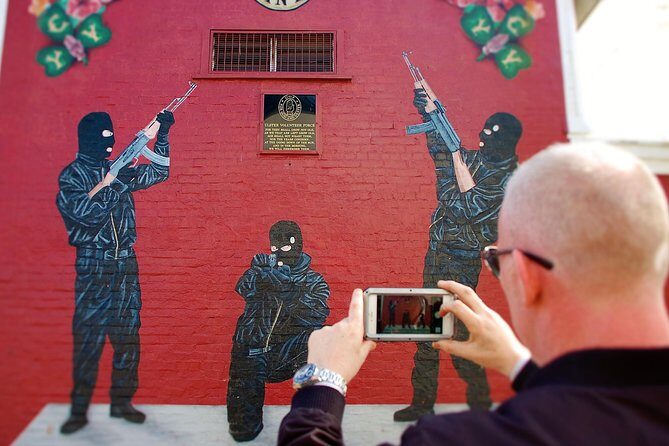
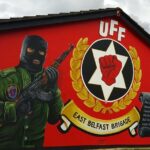
On Shankill Road, the tour shifts to the loyalist side of the divide. The info highlights that groups including the UVF and UDA are described as having been born on these streets, and it frames conflict against the IRA over decades.
This is where the tour’s balance matters most. You should come prepared for the fact that these streets represent different stories of legitimacy, protection, and resistance—each with its own emotional weight.
The stop is labeled with admission ticket not included, so if there are any paid viewing areas or access points open that day, you may need to cover them.
Also, because it’s a working city street, you may not get a perfectly quiet photo moment. That’s normal here. The best photos often happen when you pause, look around, and then move with respect.
A historic gaol building: Belfast’s jail era in view
The tour includes a look at a Belfast gaol built in the 1800s. It’s described as a hanging jail up until the 1960s and as a remand jail that housed prisoners from multiple sides, including IRA, UVF, and UFF prisoners.
Even without stepping inside, the building shape and setting help you grasp the era. Gaols like this were part of the cycle of conflict: arrests, imprisonment, and political pressure all feeding each other.
If you care about how institutions shape history, this is a useful stop. If you’re not as into architecture or prison-era context, just take it in as a reminder that the conflict wasn’t only street-level—it was also administrative and legal.
Saint Peter’s Cathedral and the song tied to the conflict
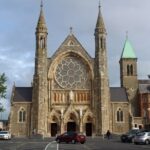
Next up is Saint Peter’s Cathedral, described as an outstanding craftwork built in the 1800s. The guide also notes that a local priest penned the famous Republican song referred to in the tour info as the fog Drew.
This is a chance to shift gears. Cathedrals and churches are often where people keep culture and memory even during political turmoil. The moral here is simple: identity survives in places of worship and in the music people sing when words become risky.
It’s also a reminder that not everything you’ll see in Belfast Troubles touring is grim. Some of it is about language, art, and how communities kept their voices.
Shankill Graveyard: mural photo time on gable walls
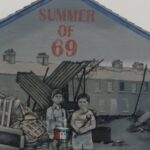
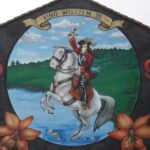
The tour ends with Shankill Graveyard, where you get time to get out and take photos of political murals painted by locals on gable walls. The Shankill stretches to lower and upper areas, and you’ll have a short window to capture street art angles from near the ground level.
This stop is different from the peace wall and the big mural surfaces. Here, the mood feels more grounded and reflective. The murals are still political, but they’re also close to where people remember.
If you care about photography, plan to slow down. Don’t just snap. Look for layering: text, symbols, color choices, and how messages sit against building surfaces.
What I like most about the guides (from the best experiences)
This tour’s reputation ties strongly to guide performance. In the high-scoring experiences, names like John, Brennan, and Brendan show up as standout drivers who tell the story with care.
The pattern is consistent: guides spend extra time explaining context so you can follow why each mural matters. They also aim for balance, including perspectives from both sides of the conflict. One guide mentioned the personal goal of peace, which fits the itinerary’s focus on peace walls and public messaging.
If you’re the kind of traveler who asks tough questions, you’ll likely appreciate that the driver isn’t afraid to talk plainly. If you’re more reserved, you can still get a lot out of the ride; you just might ask for clarification when you feel a symbol or name is passing too fast.
Who this tour suits best (and who might want a different plan)
This is a strong pick if:
- you want a short, focused way to understand Belfast’s Troubles through murals and street landmarks
- you value private attention in a politically charged setting
- you like getting out for photos instead of doing everything from a car window
It may be less ideal if:
- you want a light, purely entertainment-style city tour
- you’re not comfortable with references to violence, prison history, and paramilitary groups
- you’re expecting every stop to be fully ticket-free (some sites are marked admission not included)
Because the tour is about meaning, not just sights, it helps to come with at least a basic curiosity about the Troubles. If you do, the route becomes easier to follow minute by minute.
Should you book this Belfast Troubles and Peace Cab Tour?
I’d book it if you want the most efficient way to connect Belfast’s past to its walls and streets. The mix of international murals, local political messaging, and the peace wall moment gives you a fuller picture than a single neighborhood tour.
If you’re close enough for free pickup near Belfast City Hall, you’ll feel the value more. If you’re farther out, factor in the cash surcharge for pickup and any admission not included at specific stops.
Finally, go in expecting balance and context, not a debate club. This works best when you treat the streets like a living museum—one with real people behind the messages.
FAQ
How long is the private Belfast Troubles and Peace cab/taxi tour?
It runs for about 2 hours (approx.).
Where does the tour start and end?
You meet at Belfast City Hall (Donegall Square N, Belfast BT1 5GS) and the tour ends back at the meeting point.
Is pickup included?
There is free pickup from within 1 km of Belfast City Hall. Other pickup locations may require a cash surcharge paid on the day.
Can I get picked up from the airport, train station, or cruise port?
Pickup from airports, train stations, and cruise ship ports is not included and involves a cash surcharge paid on the day.
What language is the tour offered in?
The tour is offered in English.
Are any admissions or tickets included?
Some stops are marked as admission ticket not included, including International Mural Wall Divis Street and Shankill Road. Other listed stops are marked free.
Is this tour suitable for children?
Children must be accompanied by an adult. Most travelers can participate.
What is the cancellation refund policy?
You can cancel up to 24 hours in advance for a full refund. If you cancel less than 24 hours before the start time, the amount paid is not refunded.
You Might Also Enjoy
More Tour Reviews in Belfast
- Titanic Belfast Entrance Ticket: Titanic Visitor Experience Including SS Nomadic
★ 4.5 · 3,698 reviews