REVIEW · BELFAST
Official World Famous Belfast Taxi Tour ™
Book on Viator →Operated by Giants Causeway Tours · Bookable on Viator
If you want Belfast to make sense fast, start here. This private taxi tour takes you straight to the city’s most talked-about murals, Peace Walls, and memorial sites, with a local guide who can explain what you’re seeing and why it still matters. I love the hands-on access to the street art areas plus the chance to get up close, and I especially like the way your guide connects the murals to real people and real events. The only real drawback: some stops are heavy and graphic-adjacent, so it’s not a “light day out” kind of tour.
You’ll cover a lot in about 1 hour 30 minutes to 2 hours, with frequent short photo stops and car-to-car storytelling. Guides I’ve seen highlighted by name include Paula, Joe, Billy, Neil, and Barry, and the common thread is a no-fluff, question-friendly style that keeps the tour moving while still letting you absorb what you came for.
In This Review
- Key highlights and what they mean for you
- Why a Belfast taxi tour works better than a bus day
- Price, value, and the reality of what $90.98 buys you
- Your guide experience: what to expect from Belfast locals
- The route: murals, Peace Walls, and memorial sites (stop by stop)
- Stop 1: Bobby Sands Mural at the International Wall (Falls Road area)
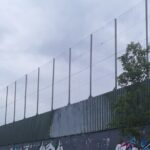
- Stop 2: The Peace Wall (and writing a message of hope)
- Clonard Monastery and the idea of no-man’s land
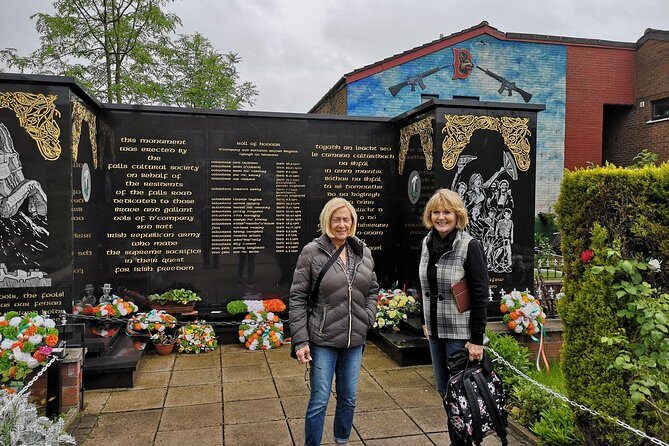
- Clonard Gardens: C Company Clonard Martyrs Memorial Garden
- Shankill Road: Loyalist UDA/UVF murals and King Billy (King William of Orange)
- International Wall / Divis Street mural overview (politically charged street art)
- Bayardo Bar attack context (Shankill area)
- Saint Peter’s Cathedral (Divis Street / Falls Road area)
- Cupar Way and the Peace Lines (Peace Gates)
- Clonard Martyrs Memorial Garden (repeat stop in the route sequence)
- Sherbrook Street / armed Loyalist mural viewing (photo stop)
- Shankill Road Memorial Garden: Bayardo Memorial Garden
- Garden of Remembrance: IRA Belfast Brigade D Company
- Welcome Wall and Divis Tower (British Army sniper nest)
- What I’d prep yourself for: the emotional weight and the visuals
- Who this taxi tour fits best (and who should consider alternatives)
- Small things you can do to get more from every stop
- So should you book it?
- FAQ
- How long is the Official World Famous Belfast Taxi Tour?
- How much does the tour cost?
- Is this a private tour?
- Does the tour include hotel pick-up and drop-off?
- Where does the tour start and end?
- What language is the tour offered in?
- Are tickets or admissions included for the stops?
- Do you get time to take photos and step out of the vehicle?
- Is a Peace Wall message-writing activity included?
- Do I need to tip the guide?
Key highlights and what they mean for you
A private taxi route built for speed so you can see both sides of the city without guessing where to go next.
Peace Walls up close, plus a message-writing moment that turns a photo stop into something more personal.
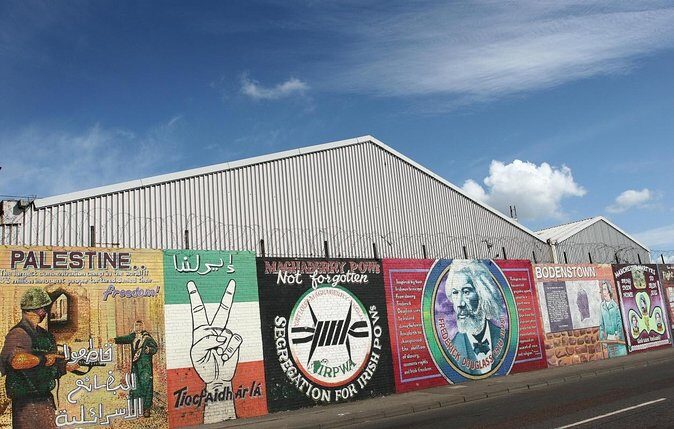
Memorial gardens and key murals with context so the art isn’t just pretty paint.
Guides with lived experience of The Troubles who can answer the hard questions directly.
Short stops designed for photos and real viewing (not long museum marathons).
You might handle plastic and rubber bullets used by British Crown Forces, if your guide includes this as part of the tour experience.
Why a Belfast taxi tour works better than a bus day
Belfast can feel confusing at first, especially when the city’s neighborhoods and identities can look “small” on a map but feel massive in real life. A taxi-style setup solves that. You’re in a car with a local route, which means you’re not spending your precious hours with a plan that depends on perfect navigation.
The format is also built around viewing, not just passing by. Instead of one long stop that burns time, you get a sequence of short moments—enough to photograph, read what’s there, and step away from the vehicle to look closer when the artwork is the point.
And the big win? Your guide acts like an interpreter for what you’re seeing. The murals in Belfast are political and religious signals made in public. Without context, they can turn into a blur of color. With context, they become a timeline you can walk through.
Other black taxi & cab tours in Belfast we've reviewed

Price, value, and the reality of what $90.98 buys you
At $90.98 per person for a private tour, you’re paying for three things: time, local access, and story.
- Time: the tour runs about 1.5 to 2 hours. In that window, you’re taken to multiple major sites tied to The Troubles and its lasting legacy.
- Local access: some locations are best handled by someone who understands the street-level context. You’ll also be doing quick stops where it matters that you arrive smoothly and on schedule.
- Story: the driver/guide is the main ingredient. The stops only become meaningful when someone explains the background clearly, without turning it into a lecture.
There are also extras that add value if they match your situation: free pick-up and drop-off from the Leonardo Hotel Belfast City Centre, air-conditioned private transportation, and a mobile ticket. If you’re traveling as a group, you may also be able to benefit from group discounts.
One thing to keep in mind: there’s no promise of long lingering at any single location. The route is designed for coverage. If you want one mural wall to dominate your day, this might feel a bit like a “great hits” tour.
Your guide experience: what to expect from Belfast locals

This isn’t an anonymous commentary audiobook. The strongest reviews highlight guides who are born and raised in Belfast and who lived through the era they’re describing. Names that come up often include Paula, Barry, Billy, Neil, and Joe—and they’re praised for being direct, engaging, and willing to answer questions without shutting you down.
What you should look for (and what helps you get more from the tour):
- A guide who can explain both the symbols and the stakes behind them.
- A guide who can keep the tone respectful while still being honest about what happened.
- A guide who lets you step out for the murals and Peace Walls instead of treating everything like a drive-by.
Also note the humor: some guides mix light conversation with heavy material. That balance matters because the topics here can otherwise feel crushing.
The route: murals, Peace Walls, and memorial sites (stop by stop)
The pacing is the key. Expect multiple stops around 10 minutes each (some shorter, some slightly longer), plus plenty of photo opportunities. It’s a circuit meant to fit into 1.5 to 2 hours, so you’ll be moving and reflecting at the same time.
Stop 1: Bobby Sands Mural at the International Wall (Falls Road area)
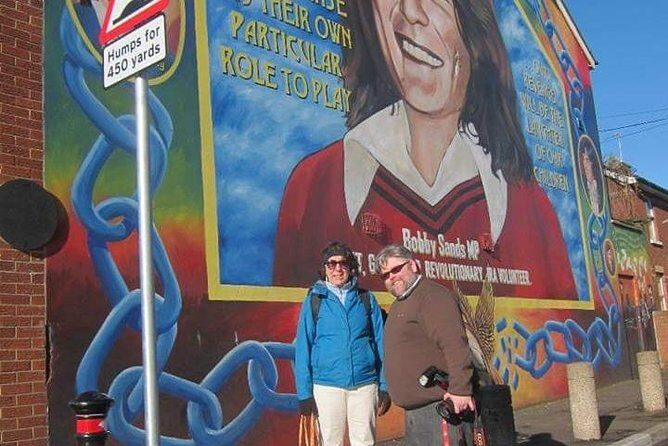
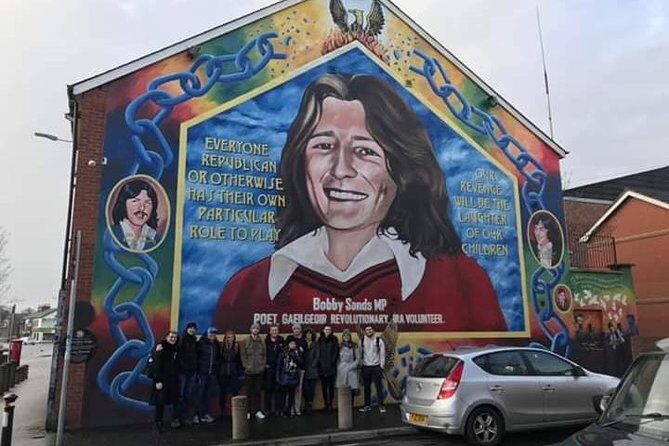
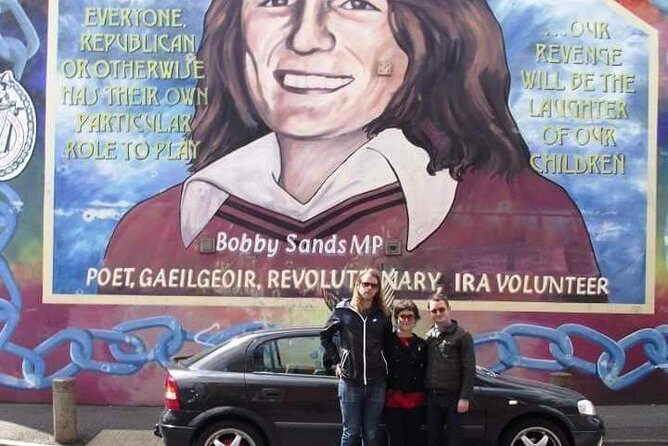
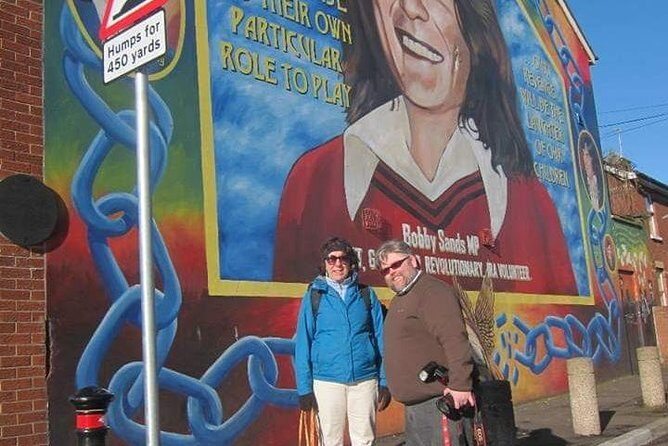
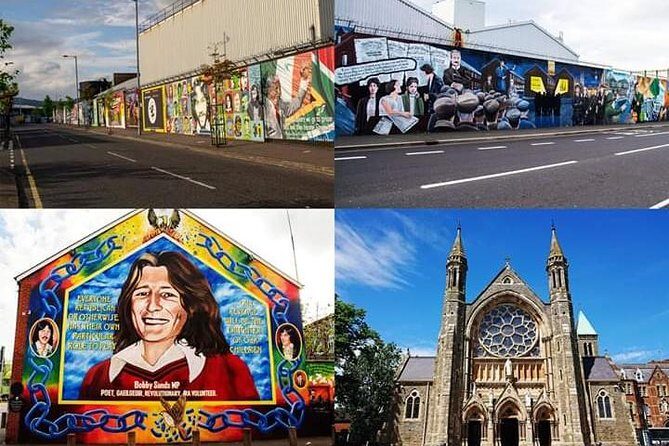
This is where the tour starts leaning into the Belfast mural tradition as political storytelling. Bobby Sands is a central figure connected to the 1981 hunger strike, and the mural area gives you a strong visual anchor.
What you’ll do here:
- See the murals at the International Wall
- Get ample photo opportunities
- Listen to the background of the conflict and how it shaped street art
Why it’s worth your attention: Belfast’s murals often act like public memory. When you understand who Bobby Sands was and why the hunger strike mattered, the mural stops looking like “just art.”
- Titanic Belfast Entrance Ticket: Titanic Visitor Experience Including SS Nomadic
★ 4.5 · 3,698 reviews



Stop 2: The Peace Wall (and writing a message of hope)
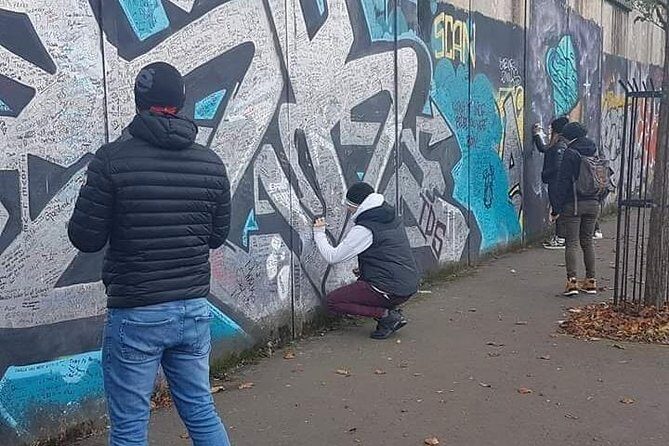
Then you hit the Peace Wall itself—an obvious, physical boundary. You’ll see it and be able to photograph it, and there’s even a moment to write your name and a message of hope on the wall. Notable signatories include Bill Clinton and the Dalai Lama.
Why I like this part for first-time visitors: it turns the idea of division into something you can actually point at. It’s hard to understand from websites. It’s easier when you’re standing there.
Possible drawback: you may feel emotional in a way you didn’t expect. That’s normal. Plan for it.
Clonard Monastery and the idea of no-man’s land
The tour includes a stop near Clonard Monastery, described as being situated right in the middle of no-man’s land.
Even if you don’t know the exact geography of the conflict, this kind of stop helps you understand why certain streets and buildings mattered. Places like this were not just “historic.” They were strategic.
Clonard Gardens: C Company Clonard Martyrs Memorial Garden
Next comes Clonard Gardens at Bombay Street, tied to IRA C Company commemorations and a memorial garden context. This stop is one of the more explicitly memorial-focused portions of the route.
What’s important here:
- The memorial context connects local civilian harm, deaths, and prisoners linked to the Greater Clonard area (1916–1970)
- You’ll learn how conflict began in 1969 (as explained by your guide)
- There are plaques connected to the commemorated groups
This is where the tour can feel intense. Some people leave thinking harder than they planned. If that’s your style, it’s a strong stop.
Shankill Road: Loyalist UDA/UVF murals and King Billy (King William of Orange)
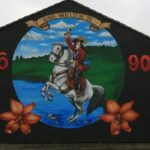
Now you swing to the Loyalist side of Belfast’s mural landscape. You’ll view the Loyalist UDA and UVF murals, including the King Billy / King William of Orange mural, and you’ll have time to take photos.
Why this matters: Belfast’s street art isn’t a single viewpoint. It’s two communities speaking loudly through the same medium.
Quick consideration: if you’re uncomfortable with openly political symbols, you’ll want to mentally prepare yourself. This is a tour built around those symbols.
International Wall / Divis Street mural overview (politically charged street art)
The route also loops you through the broader concept of murals in Northern Ireland, especially in Belfast and Derry. You may hear the idea that nearly 2,000 murals were documented since the 1970s, with around 300 quality murals estimated for Belfast in one mural guide figure.
What you’ll learn while you look:
- Murals communicate what a community values
- Themes can include hunger strike imagery, commemorations of bombings, and both nationalist and unionist perspectives
- Murals can act as messages, memorials, and identity statements all at once
This isn’t just a “read about it” stop. It helps you interpret what you’re seeing at the other mural locations.
Bayardo Bar attack context (Shankill area)
There’s a stop that addresses the Bayardo Bar attack on 13 August 1975, when a Provisional IRA unit led by Brendan McFarlane attacked a pub in the loyalist Shankill area. The guide includes details about fatalities and injuries and explains why the IRA said it targeted the pub.
Why include this? Because murals don’t float in a vacuum. Public art often points back to specific events, and if you skip the event context you lose the meaning.
Note: this section is heavy. If you’re sensitive to violent histories, be ready for a sobering stretch of your tour.
Saint Peter’s Cathedral (Divis Street / Falls Road area)
The itinerary includes St Peter’s Cathedral in the Divis Street area of the Falls Road, Roman Catholic and the episcopal seat of the Bishop of Down and Connor. Construction began in the 1860s, and it’s home to St Peter’s Schola Cantorum.
This stop is useful because it adds a religious landmark to balance the mural-only vibe. It helps you see that Belfast’s identity isn’t only expressed through conflict images; it’s also built into churches, music, and community life.
Cupar Way and the Peace Lines (Peace Gates)
You’ll also get to see the peace lines / peace walls described as separation barriers between predominantly republican/nationalist Catholic neighborhoods and loyalist/unionist Protestant neighborhoods.
The tour notes features like:
- Heights up to 25 feet (8 m)
- Gates that may allow passage during daylight and close at night
- That they exist at urban interface areas in Belfast and beyond
A quick stop here can still hit hard. Seeing a wall on camera is one thing; seeing it at street level is different. This is one of the best “get it, instantly” parts of the route.
Clonard Martyrs Memorial Garden (repeat stop in the route sequence)
The itinerary includes Clonard Martyrs Memorial Garden again. It’s not uncommon for routes like this to revisit a close-by area for different angles of explanation or because multiple items cluster around the same geography.
Use this time to ask your guide how the memorial details connect back to the murals you’ve been seeing.
Sherbrook Street / armed Loyalist mural viewing (photo stop)
There’s a brief stop at 56 Sherbrook Cl described as a place to photograph armed Loyalist murals.
These quick photo breaks matter because Belfast murals often include imagery that’s easiest to spot when you’re standing a few steps closer. A car window can blur details.
Shankill Road Memorial Garden: Bayardo Memorial Garden
The route also visits the Bayardo Memorial Garden on the Loyalist side. This brings the story of the Bayardo Bar attack back to a memorial space rather than leaving it as only a “news event.”
If you want a tour that doesn’t just point at pain but also acknowledges remembrance, this is a good inclusion.
Garden of Remembrance: IRA Belfast Brigade D Company
Next up: Garden of Remembrance, connected to the IRA Belfast Brigade D Company. Again, this is a memorial stop, and it reinforces that murals and gardens here are part of an ongoing public memory system.
Welcome Wall and Divis Tower (British Army sniper nest)
The tour includes a stop at the Welcome Wall and Divis Tower, described as the heart of the IRA’s territory and as the site where the British Army had a sniper’s nest.
This type of stop can feel like stepping into the conflict’s “how did they live like that” reality. It’s also one of the reasons this tour works best with a guide: the significance isn’t obvious from the building alone.
What I’d prep yourself for: the emotional weight and the visuals
This tour deals with “The Troubles,” and some elements are explicitly difficult. You may encounter:
- Memorials listing deaths, prisoners, and civilian casualties
- Violent historical events tied to specific places
- References to armed groups and paramilitary histories
- The mention of real plastic and rubber bullets used by British Crown Forces
That last one is worth highlighting. Handling objects like this can make the past feel painfully physical. If you think you’ll react strongly, give yourself permission to slow down, ask fewer questions, or request a moment to step back.
Practical tip: wear shoes you can stand in comfortably for multiple short stops. You’ll be stepping out for murals and walls, then back into the car. It’s not one long walk, but it is steady movement.
Who this taxi tour fits best (and who should consider alternatives)
This tour is ideal if you:
- Want the fast route through Belfast’s key mural and Peace Wall landmarks
- Like history told by locals with lived context
- Prefer a private guide where you can ask direct questions
- Are traveling with adults who can handle heavy topics responsibly
It may be a tougher match if you:
- Need a light, carefree sightseeing day
- Have children and want to avoid graphic or emotionally heavy content (the tour itself is described as including displays that can be too graphic for children)
- Get overwhelmed by political or memorial settings
For most people, the tour is “worth it” because the city becomes understandable in a way you can’t get from a quick photo walk.
Small things you can do to get more from every stop
Even with short stops, you can increase how much you take in.
- Treat photos as part of the learning, not a replacement for it. Ask what symbol stands for what, and why it appears here.
- When you reach the Peace Wall moment, consider it more than a souvenir. Writing your name and message is the kind of act that makes the history feel personal.
- If something doesn’t click (for example, why a memorial matters to this exact street), ask your guide to connect it to what you saw 10 minutes earlier. The route is designed like a chain.
And if your guide is someone like Barry or Paula, lean into their storytelling style. The best tours here aren’t “sit and listen.” They’re dialogue.
So should you book it?
I think you should book the Official World Famous Belfast Taxi Tour if your goal is to understand Belfast’s murals, Peace Walls, and lasting divisions without wasting time piecing it together on your own. The private taxi format is genuinely built for this kind of route: short stops, local context, and a guide who can connect images to events.
Skip it—or choose a different format—if you want a purely casual sightseeing day or you’re not prepared for the emotional weight of memorials and conflict-linked places.
If you’re arriving in Belfast and thinking, I want to get oriented fast, this is one of the clearest ways to do it.
FAQ
How long is the Official World Famous Belfast Taxi Tour?
The tour runs about 1 hour 30 minutes to 2 hours.
How much does the tour cost?
The price is $90.98 per person.
Is this a private tour?
Yes. It is described as a private tour/activity where only your group participates.
Does the tour include hotel pick-up and drop-off?
Free pick-up and drop-off is offered from the Leonardo Hotel Belfast City Centre. Belfast hotel/Airbnb pickup and drop-off can be requested for an extra charge (Belfast City Centre only).
Where does the tour start and end?
The start point is Leonardo Hotel Belfast, Great Victoria St, Belfast BT1 6DY. The tour ends back at the meeting point.
What language is the tour offered in?
The tour is offered in English.
Are tickets or admissions included for the stops?
Some stops list admission as free or included. The tour also includes access to key sites like murals and Peace Walls up close.
Do you get time to take photos and step out of the vehicle?
Yes. The itinerary is built around short visits for viewing and photography, including stepping out for murals and Peace Walls.
Is a Peace Wall message-writing activity included?
Yes. You can write your name and leave a message on the Peace Wall.
Do I need to tip the guide?
Tips are not included.
You Might Also Enjoy


More Tours in Belfast

More Tour Reviews in Belfast
- Titanic Belfast Entrance Ticket: Titanic Visitor Experience Including SS Nomadic
★ 4.5 · 3,698 reviews